
Google Unveils Gemini 4 Argon and Major AI Ecosystem Upgrades in September 2026
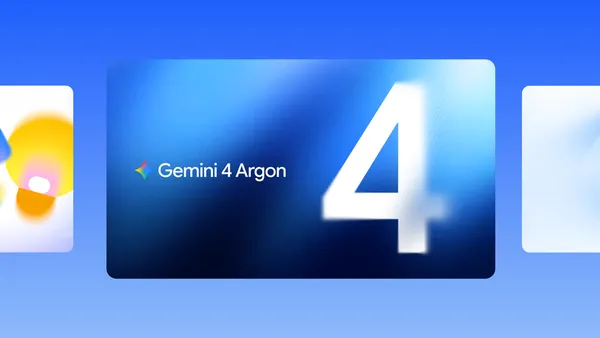
Google has released a comprehensive roundup of its major Artificial Intelligence advancements from September 2026, signaling a massive push into frontier AI capabilities, advanced reasoning, and deep enterprise integration. The announcements cover everything from next-generation large language models (LLMs) to sophisticated voice tools and groundbreaking scientific applications, solidifying Google's position as a leader in AI infrastructure and deployment.
The centerpiece of these announcements is the introduction of Gemini 4 Argon, a powerful new frontier model. This model is engineered specifically to tackle the most complex and challenging problems, distinguishing itself with an industry-leading 1-million-token context window. This massive context capacity is crucial because it allows the model to process, analyze, and maintain coherence over extremely large volumes of data—far exceeding the capabilities of previous generations. Argon is designed for heavy-duty, high-stakes workloads, including sophisticated coding tasks, comprehensive cybersecurity defense, and complex knowledge work such as detailed financial research and meticulous legal drafting. Due to the immense power and potential scope of these frontier capabilities, Google is adopting a cautious, phased rollout approach. Argon is currently being deployed through the specialized Fairwind Program, initially targeting trusted cybersecurity defenders. This phased release strategy is vital for gathering real-world feedback, allowing Google to rigorously refine the model's guardrails and safety mechanisms before expanding its availability to the broader developer, enterprise, and consumer markets.
Complementing Argon, Google also advanced its existing model family with Gemini 3.8 Flash and Gemini 3.8 Flash Cyber. The Gemini 3.8 generation represents a significant leap in reasoning and coding performance, achieving these improvements while maintaining the speed and cost efficiency associated with the 3.7 Flash model. Gemini 3.8 Flash is particularly noted for providing substantial gains in long-horizon software engineering projects, multi-step problem-solving, and complex agentic workflows—the kind of tasks where an AI needs to plan and execute a sequence of actions over time. For the security sector, Gemini 3.8 Flash Cyber is a specialized tool that equips defenders with frontier-grade capabilities, including autonomous vulnerability discovery and automated code patching. Like Argon, this powerful tool is restricted to trusted organizations via the Fairwind Program, underscoring Google's commitment to responsible AI deployment in critical infrastructure.
Beyond the core LLMs, Google dramatically enhanced its multimodal and conversational interfaces. The launch of Gemini 3.8 Live and Gemini 3.8 Live Extended Thinking marks a major breakthrough in natural voice interaction. Gemini 3.8 Live is designed for everyday, fluid conversation, while the Extended Thinking variant is specifically optimized for multi-step reasoning, allowing users to engage in complex, back-and-forth discussions without the typical latency or lag associated with deep thinking processes. These advanced voice models are immediately accessible to developers through Google AI Studio and the Gemini API, and they are being integrated across core Google services, including Search Live, Gemini Live, and Google Workspace. This integration means users can now perform complex tasks—such as drafting emails in Gmail, creating documents in Docs, or managing notes in Keep—entirely using natural voice commands, fundamentally changing how people interact with productivity software.
Furthermore, the audio generation capabilities received a creative overhaul with the introduction of Gemini 3.8 Flash-Lite TTS and Gemini 3.8 Flash TTS. These models move far beyond static, fixed voice presets. They establish a dynamic creative studio, enabling users to generate highly expressive, custom voices and even direct specific scene dialogue simply from text prompts. This capability is set to elevate audio experiences across multiple products, including Gemini Notebook and Google Vids, allowing developers to build sophisticated, voice-first applications that were previously difficult or impossible to create.
In terms of user experience and connectivity, Google significantly expanded the utility of the Gemini app by introducing Connected Apps. This feature allows users to seamlessly integrate a vast array of third-party and productivity platforms directly into the Gemini interface. The list of supported apps is extensive, covering productivity tools like Airtable, Linear, and monday.com; creative platforms such as Adobe, Picsart, Squarespace, and Webflow; and essential lifestyle services like Peloton and Experian. This integration eliminates the need for users to constantly switch between different applications or tabs, creating a unified, centralized workspace where AI can interact with and manage data across multiple services simultaneously.
Google's reach extends into the physical and scientific worlds. The company announced major scientific milestones, including the mapping of human DNA through the AlphaGenome Atlas, a monumental effort in genomics. Simultaneously, they are utilizing AI to track global methane emissions from space, providing critical data for climate change monitoring. Furthermore, the launch of Project Suncatcher demonstrates Google's commitment to advancing machine learning hardware in orbit. On the consumer side, the availability of Gemini on Windows and the pre-order launch of the Googlebook laptop solidify the physical ecosystem supporting these advanced AI features. Overall, the September announcements confirm Google's strategy of building a deeply integrated, multi-layered AI ecosystem that spans from foundational models (Argon) to consumer interfaces (Voice/Apps) and critical scientific research.
This period of rapid development was also marked by recognition for Google's teams, whose work on designing superior AI interfaces was named the 2026 Design Company of the Year by Fast Company. This underscores that Google's focus is not just on raw computational power, but on making that power accessible, intuitive, and aesthetically pleasing for the end-user, ensuring that the next era of intelligence is both powerful and usable.
Why it matters
- —The release of Gemini 4 Argon establishes a new benchmark for frontier AI reasoning with its massive 1-million-token context window.
- —The deep integration of Connected Apps streamlines workflows by bringing third-party services directly into the Gemini interface.
- —The advancements in voice and text-to-speech models (3.8 Live/TTS) revolutionize natural human-computer interaction across Google Workspace.
Key facts
- Gemini 4 Argon is a new frontier model designed for complex tasks like cybersecurity and legal drafting.
- The Gemini 3.8 Live and Extended Thinking models enable natural, multi-step voice conversations across Google Workspace.
- Connected Apps integrate major third-party tools (e.g., Adobe, Airtable) directly into the Gemini platform.
- Scientific initiatives include mapping human DNA (AlphaGenome Atlas) and tracking global methane from space.
The full text is in the original source. Here we provide a brief summary and key facts.