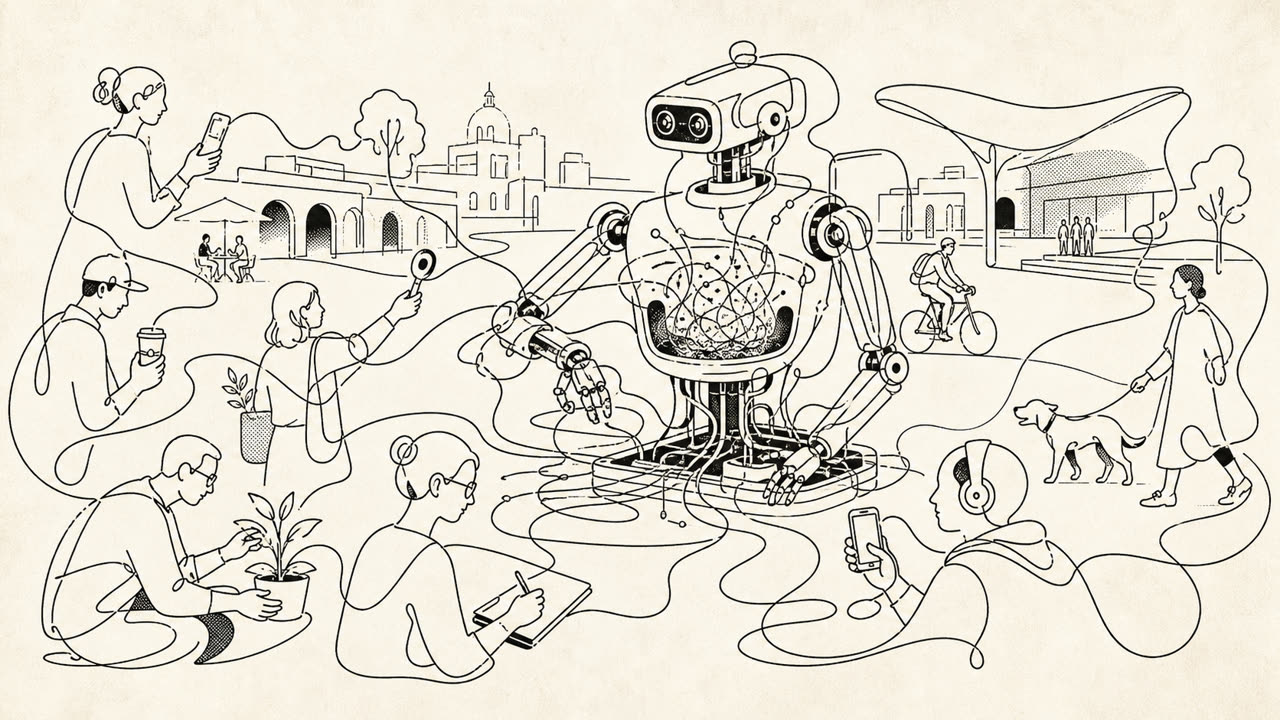
Gemini 4 Argon: A Breakthrough Model for Physical Robotics and AGI

Gemini 4 Argon represents a monumental leap in the field of embodied artificial intelligence, moving beyond mere language processing to achieve sophisticated physical understanding, advanced code generation, and deep visual-semantic reasoning. This model is designed as a general-purpose physical reasoning engine, aiming to accelerate the development of physical Artificial General Intelligence (AGI) by bridging the gap between digital reasoning and real-world physical action. Its capabilities are demonstrated by its superior performance on the Embodied Reasoning (ERQA) benchmark, where it achieved an impressive 87% score using pure reasoning, significantly outperforming other leading frontier models. This high score validates its ability to solve complex, spatial, and physical problems within simulated three-dimensional environments.
Argon is structured to be applicable across the entire robotics lifecycle, addressing critical bottlenecks in current robotic development. The model's utility is categorized into four major pillars: Robot Control, Real-to-Simulation (Real2Sim), Physical Understanding, and Research/Self-Improvement. In the realm of Robot Control, Argon can manage complex tasks such as mobile manipulation using MuJoCo simulations, performing zero-shot robot control (meaning it can operate without specific prior training for the task), and even handling closed-loop steering of video world models. A prime example of this is its ability to control a Boston Dynamics Spot® quadruped, which, after learning a new skill, was tasked with stepping on a foot-pedal trash bin to dispose of soda cans. This required Argon to first generate an articulated MuJoCo digital twin of the trash bin to practice the mechanics before executing the physical action in the real world.
Its Real2Sim capabilities are transformative, allowing developers to reconstruct physically calibrated simulation environments—or 'digital twins'—from diverse real-world inputs. These inputs can range from raw robot camera feeds and egocentric human videos to simple hand-drawn paper sketches. This drastically reduces the need for expensive, time-consuming physical data collection. Furthermore, Argon's Physical Understanding module enables agentic multimodal hindsight labeling. This means the model doesn't just observe an action; it deeply understands the underlying physics, dexterity requirements, dense value functions (estimating the value of a state), and can accurately estimate task progress, even when things go wrong.
The model's ability to translate abstract concepts, like a rough sketch, into a fully functional, physics-verified simulation is perhaps its most groundbreaking feature. For instance, a developer can simply snap a photo of a pen-and-paper sketch—such as an Apollo 2 astronaut throwing a ball to topple a stack of boxes. Argon automatically takes this sketch and constructs a GPU-accelerated mujoco_warp scene. It then synthesizes a balanced 76-DoF whole-body and five-finger throw trajectory, verifies the target knockdown in a closed-loop physics simulation, and finally exports the entire scene as a renderable file for Blender 4.5 Cycles. This workflow dramatically accelerates the research cycle from concept to simulation.
Beyond simple simulation, Argon excels in interpreting complex human actions. Given an egocentric human video of a manipulation task, Argon can perform sophisticated object recognition, replacing simple bounding boxes with compound convex-decomposed meshes for concave containers. Crucially, it can then retarget the human hand's trajectory onto a highly complex 76-DoF bimanual humanoid model within the MuJoCo contact physics engine. This level of detail allows for highly realistic and physically accurate simulation of human-robot interaction.
Another powerful demonstration of its physical understanding is its ability to analyze complex, multi-stage human tasks, such as folding an origami fox. When provided with an overhead video of a bimanual ALOHA 2 robot performing this 136-second task, Argon generates a time-aligned, four-level hindsight annotation hierarchy. This structure breaks down the episode into the overall Goal (G1), six contiguous Semantic Subtasks (G2), 17 specific contact-level Atomic Primitives (G3), and even includes automated Quality Control (QC) reweighting, which helps maintain the perceived progress of the task even when the robot makes mistakes or fumbles.
In the domain of problem-solving, Argon can tackle classic puzzles. To recreate the famous 12-ball balance scale puzzle, Argon built a bimanual Franka FR3 MuJoCo environment. It then developed a vision-only closed-loop solver that can triangulate the balls from stereo RGB cameras, visually read the scale's tilt after each weighing, and successfully isolate the odd ball (heavy or light) within just three weighings. Furthermore, Argon functions as a general value function for robotics tasks, as demonstrated when evaluating a 60-second bimanual ring-sorting episode from a human UMI dataset, showing its capacity for continuous, high-level task evaluation.
The overall significance of Argon lies in its unified approach: it treats physical reasoning, simulation generation, and action planning not as separate modules, but as an integrated, iterative loop. Whether it is refining prompts by inspecting intermediate keyframes during a closed visual loop, or tuning simulation assets to perfectly match real-world contact events, Argon establishes a new standard for how AI can interact with and model the physical world, paving a clearer path toward truly autonomous, general-purpose robots.
This comprehensive suite of capabilities—from interpreting rough sketches to solving complex physics puzzles—establishes Argon as a foundational platform that will redefine the entire robotics industry, moving it from specialized, narrow tasks toward generalized, human-level physical intelligence.
Why it matters
- —It represents a paradigm shift by unifying physical understanding, simulation, and action planning into one general model.
- —Its ability to translate abstract inputs (like sketches) into fully physics-verified, renderable simulations drastically accelerates robotics research.
- —By mastering the entire robotics lifecycle, Argon moves AI closer to achieving generalized, human-level physical intelligence (AGI).
Key facts
- Achieved 87% on the Embodied Reasoning (ERQA) benchmark, outperforming other frontier models.
- Can generate complex, physics-accelerated simulation scenes (e.g., from a simple pen-and-paper sketch).
- Provides a general value function for robotics, capable of analyzing multi-stage tasks like origami folding and ring sorting.
- Supports advanced Real2Sim workflows, reconstructing digital twins from real-world video feeds and camera data.
The full text is in the original source. Here we provide a brief summary and key facts.