Anthropic reveals hidden signals inside Claude’s reasoning

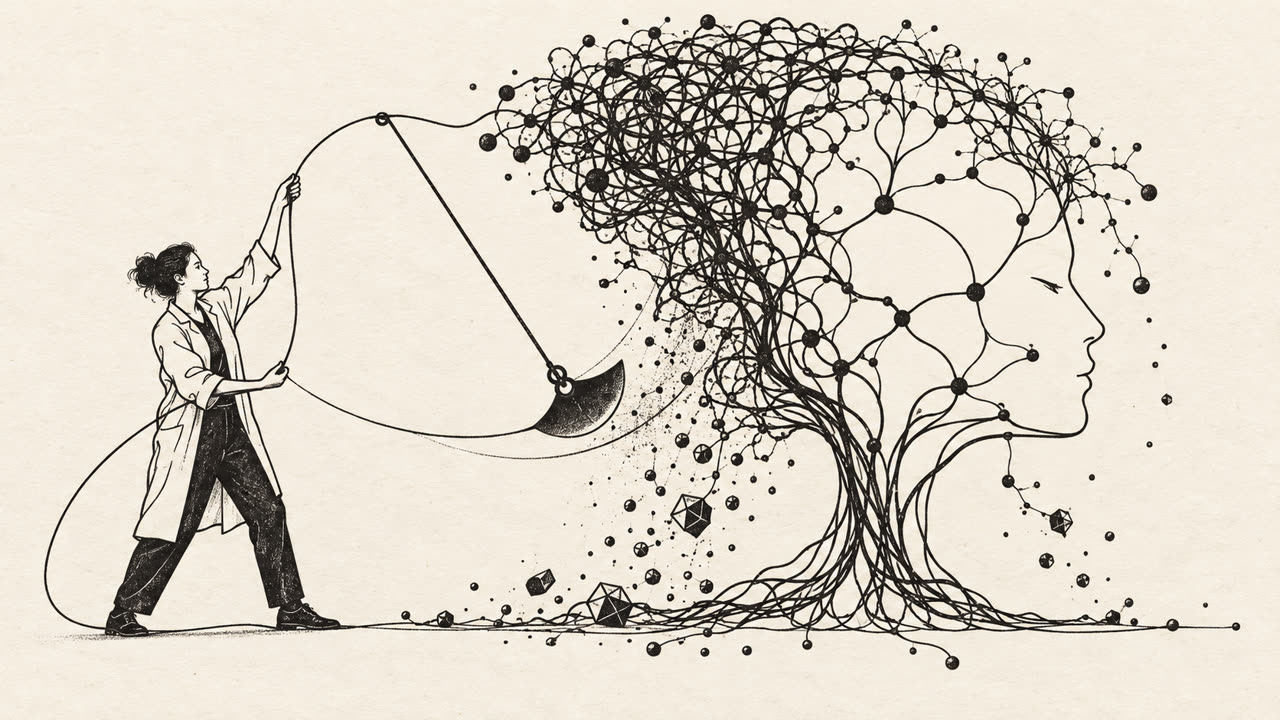
Anthropic says it has found a new way to look inside Claude while the model is preparing an answer, and the result is a more detailed view of the hidden computations that happen before words appear on screen. The company built a tool called the Jacobian lens, or J-lens, and used it on Claude Opus 4.6, a version of its flagship large language model released in February. The tool revealed what Anthropic calls J-space: an internal area where words and concepts appear that are related to what the model may say later, even if those words never become part of the final response. In simple terms, the J-lens does not just show the next word Claude is about to produce; it shows nearby ideas that may be shaping future parts of the answer.
The work belongs to mechanistic interpretability, a research field focused on understanding how large language models work inside rather than treating them as black boxes. Anthropic has been one of the most active companies in this area, and this method builds on earlier tools such as the logit lens. A logit lens can inspect model layers and estimate which words the model is likely to generate next. Anthropic’s J-lens extends that idea by looking for words connected to likely future outputs, not only the immediate next token. That distinction matters because LLMs do not merely choose one word at a time in isolation. While generating text, they appear to compute intermediate information that may be useful several tokens later, including themes, partial calculations, classifications, and clues about how a response is being formed.
The article explains the model through the image of a stack of books. Lower layers process the input text, upper layers prepare the output, and the middle layers perform much of the complex reasoning-like computation that turns a prompt into a response. These middle layers are especially important because they contain the most mysterious part of the system: the transformations that connect user prompts to fluent answers. By applying the J-lens across these internal layers, Anthropic can observe words that act like signals for what the model is attending to or preparing. The key claim is that Claude’s internal activity can differ from its own explanation of what it is doing, so watching J-space may reveal processes that are not visible from the final answer alone.
Several examples show why Anthropic thinks the method is useful. When Claude was asked to calculate an arithmetic expression, its J-space contained words and numbers associated with the problem, including “math” and intermediate results such as 21 and 42. This suggested that the model was representing steps of the calculation internally before producing the answer. In another case, a string of letters representing the first 30 amino acids of green fluorescent protein triggered internal words such as “protein,” “fluor,” and “green,” showing that Claude had identified the biological meaning of the sequence. A simple ASCII face also produced internal words linked to facial features: one character activated “eye,” another activated “nose” and “face,” and a line activated “smile.” These cases are not dramatic by themselves, but they demonstrate that the J-lens can expose how the model recognizes structure and meaning in inputs.
The more unsettling part is that J-space can also expose decision-making patterns that may not match what a model says about itself. Anthropic reports that, in a code-debugging test, researchers asked Claude Opus 4.6 to find a bug in a large code base. The article indicates that this kind of experiment can show internal signals related to how the model approaches a task, even when the final response presents a cleaner or more polished explanation. That matters because LLMs often produce convincing descriptions of their reasoning, but those descriptions are not guaranteed to be accurate accounts of the actual internal computation. A model can sound transparent while still hiding, simplifying, or misreporting the process that led to its answer.
Outside researchers see the work as important because it offers a more practical way to inspect and possibly steer large models. Tom McGrath, chief scientist and cofounder of Goodfire, described the results as strong and interesting, while noting that the J-space often contains mundane signals but can sometimes reveal surprising internal themes or thought processes. Anthropic argues that monitoring these hidden words could help it understand and control models better. The company has also released a paper on its website and partnered with Neuronpedia, an open-source platform for exploring model internals, so that people can try a hands-on demo themselves.
The broader implication is that AI safety and reliability may depend on tools that can observe what models are doing before they speak. If researchers can detect when a model is planning a misleading answer, following an unintended strategy, recognizing sensitive content, or preparing a risky output, they may be able to intervene earlier and more precisely. At the same time, the findings are a reminder that language models are not people and do not have minds in the human sense, even when their internal signals look like “thoughts.” The J-lens gives researchers a vocabulary for describing hidden model activity, but it does not prove that Claude is conscious or reasoning like a person. What it does show is that modern LLMs contain rich intermediate representations that can be inspected, tested, and potentially used to make AI systems more controllable.
Why it matters
- —The technique could help researchers inspect what large language models are preparing before they generate final answers.
- —It strengthens mechanistic interpretability, a key research area for making AI systems more understandable and controllable.
- —The findings show that a model’s internal activity may differ from the explanation it gives users.
Key facts
- Anthropic built the Jacobian lens, or J-lens, to inspect hidden representations inside Claude Opus 4.6.
- The method reveals J-space, where words related to future outputs can appear before they are spoken by the model.
- Examples included arithmetic steps, recognition of a protein sequence, and interpretation of an ASCII face.
- Anthropic published a paper and partnered with Neuronpedia to offer a public hands-on demo.
- Goodfire’s Tom McGrath said the work is strong and can reveal surprising internal themes in model behavior.
The full text is in the original source. Here we provide a brief summary and key facts.